Parrot Puppet using Ball
 Objective
 Objective
To guide teachers in creating a colourful Parrot Puppet that can be used in classrooms for storytelling, rhymes and activity-based learning
Estimated time to create the Parrot Puppet using Ball
20 -30 minutes
Materials required for creating the Parrot Puppet using Ball
- Glue drops or Diluted Fevicol
- Scissors
- Plastic Ball
- Tissue paper
- Green paint
- Brush
- Red A4 sheet paper
- Google eyes
Preparation for activity
- Arrange all materials neatly on the workspace before beginning.
- Pre-cut coloured paper into smaller pieces to make pasting easier.
- Ensure the tubes for finger puppets are cut and made properly for puppet balance.
- Use only child-safe scissors if children are participating.
Procedure
Hello everyone! Welcome to this puppet-making session. Today, we’ll make a ‘Parrot Puppet’
- Step 1:
- We will see how to make the parrot’s body with a plastic ball and its beak with red coloured paper. We will also look at how to move the puppet.
- Step 2:
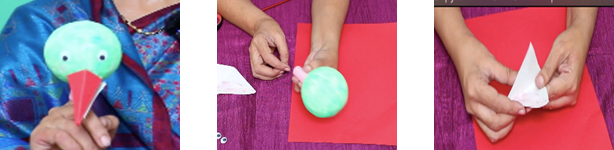
- Take a plastic ball and stick a few pieces of tissue paper on the ball to cover it entirely. Use diluted glue to stick the tissue paper.
- Step 3:
- Paint the ball green by applying green colour paint on the tissue paper stuck to the ball. Colour only one side of the ball as shown in the video.
- Step 4:
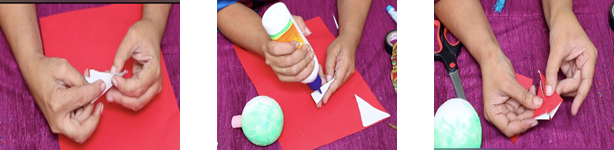
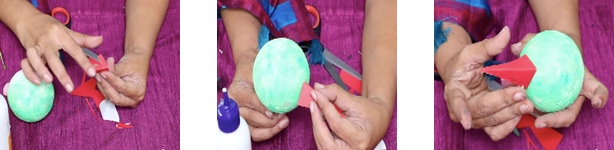
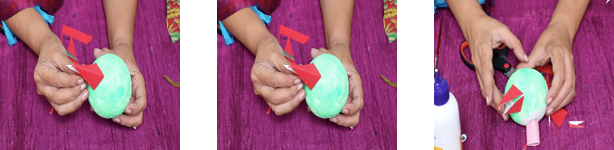
- Now let’s learn how to put the beak on the parrot’s face. For this, take a two-layered triangle sheet. Fold it in half and attach the base of the folded triangle sheet onto the ball such that the pointed side faces outside, like a beak. Cut the folded sheet short, since it is the beak of a parrot. Make two parts with the two folded sheets and stick them on red coloured paper. Make a sturdy base as shown in the video and stick the upper and the lower parts of the beak on the ball (face of the parrot).
- Step 5:
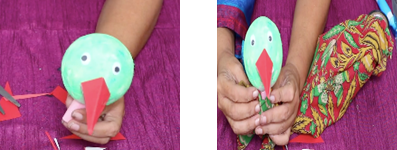
- Attach googly eyes above the beak. Make a cylinder out of chart paper and stick it on the ball from below the face to hold the puppet.
- Step 6:
- We can even put a dress on the parrot. Now your Parrot Puppet is ready! You can use it in rhymes, stories, or role plays.
Step by Step Pictures to create the puppet
Important Tips
- Use thick chart paper to make the puppet durable.
- If coloured paper is unavailable, colour the puppet using crayons or sketch pens.
- Keep the design bright and friendly to attract children’s attention.
- Practice simple wing movements before the class to make the parrot appear lively.
Precautions
- Always supervise children when using scissors or rods.
- Avoid excess glue to prevent wrinkles or tears.
- Let the puppet dry completely before use.
- Keep the puppet facing the audience during the demonstration.
- Ensure rods are not sharp or pointed.
Troubleshooting:
- Problem: Puppet does not stay upright.
Solution: Reposition rods evenly and check glue placement. - Problem: Beak comes loose.
Solution: Apply a small amount of glue and press firmly for a few seconds. - Problem: Puppet bends after use.
Solution: Use thicker chart paper or add a second layer for support. - Problem: Colour looks dull.
Solution: Use bright chart paper or outline features with a black pen for contrast.
 Notes to the Teacher
- Puppet-making encourages creativity, coordination and fine motor skills.
- The Parrot Puppet can be used in lessons on birds, colours and nature.
- Teachers can name the puppet (e.g., “Polly the Parrot”) to make it relatable for children.
- Encourage students to make their own puppets and use them in classroom plays or rhymes.
- Use this activity to discuss topics like kindness to animals or conservation of birds.
Different ways of using the puppet in class:
- Storytelling: Use the parrot as a character in stories like The Talkative Parrot or The Parrot and the Merchant.
- Language Development: Practice dialogues, describing the parrot’s colours, or speaking lines like “Polly wants a cracker!”
- Rhymes and Songs: Use during songs such as Two Little Dicky Birds or Early in the Morning.
- EVS: Introduce bird habitats, beaks, feathers, or the role of birds in nature.
- Art Integration: Encourage children to create different coloured parrots and display them in class.
Encourage students to present a short skit or rhyme using their own parrot puppets.
Video: How to use Learning Teaching Material
| Source and Attribution of images All images used in the above Assets and Aids are originally created. |
| This digital material has been developed by the Sri Sathya Sai Vidya Vahini Inclusive Education Project, a unit of Sri Sathya Sai Central Trust, Prasanthi Nilayam, as a collaborative offering in the service of our nation. |