Animal Camera Roll
 Objective
 Objective
To learn about different animals using visual learning.
Estimated time to create the Animal camera roll
40 to 60 minutes
Materials required for creating the Animal camera roll
- Cardboard Box (Amazon/Flipkart delivery boxes)
- Coloured Papers
- Fevicol/ Glue gun
- Scissors/ paper cutter
- Sketch pens, crayons, paints
- 2 Wooden Sticks
- Animal printouts
Preparation for activity:
Keep all materials ready in advance. Teachers can select in advance the animals that should be taught in class.
Procedure
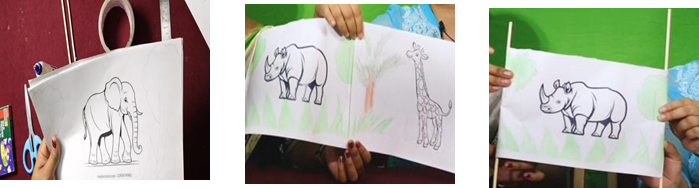
- Take printout papers according to the size of the box and cut them. Use colorful pens and crayons to decorate them creatively.
- Once colouring is done, stick all the papers together end to end. Take two wooden sticks and using glue, roll and paste the paper edges onto them so the animals appear in sequence while rotating it.
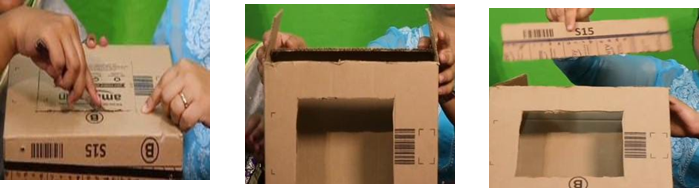
- Cut the front portion of the box to make a frame-like window for displaying the animals. Decorate the box to make it look like a camera.
- Remove the top (larger) flaps; these can later be used to close the box.
- Make two holes on the top part of the box as well as inside the box to insert the sticks inward, allowing them to come out from the bottom. Repeat the same for the other side.
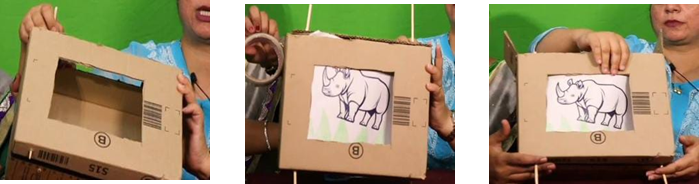
- Take the paper reel (with animal drawings) pasted on the sticks and insert it inside the box so that the images appear clearly through the frame window.
- Close the box from the top using the flaps removed earlier. Make two holes on the flap so the sticks can pass through. Secure the flap with cello tape.
Step by Step Pictures to create the Animal camera roll
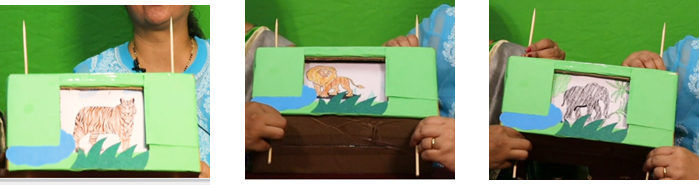
Important Tips
- Animals can also be illustrated on paper, ensuring they are coloured accurately so that students can easily recognize them.
- This activity may be extended beyond animals to introduce related concepts such as different types of climates, varieties of birds or broader ecological themes.
- While introducing animals, teachers should include the names of specific animals alongside the illustrations. This reinforces visual recognition with linguistic association, aiding memory retention.
- Alternatively, if labels are omitted, teachers can prompt students to identify the animals independently, thereby fostering critical thinking and observation skills.
- The teacher can also include both wild and domestic animals to help students differentiate between those that inhabit forests and those that can live in human environments.
 Notes to the Teacher
Through this model, teachers can effectively introduce students to different types of animals. It is also beneficial for children with disabilities, as it encourages creativity and supports skill development.
Using the Learning Teaching Material
The teachers can make this activity to make students learn visually about animals.
Video: How to use Learning Teaching Material
| Source and Attribution of images All images used in the above Assets and Aids are originally created. |
| This content is jointly developed by Sri Sathya Sai Vidya Vahini Inclusive Education Project, a unit of Sri Sathya Sai Central Trust, Prashanthi Nilayam, and All India Institute of Speech and Hearing (AIISH) as an offering in the service of our nation, for the benefit of CWSN. |