
Public Places
 Objective
 Objective
To teach children about public places and professions.
Estimated time to create the model for public places
60 to 90 minutes
Materials required for creating the model for public places
- Cardboard
- Scissors
- Fevistick/ hot gum
- Pencil, scale, eraser
- Printouts of pictures of public places
- PVC pipe/wooden pipe
- Velcro
- Plastic models of professionals (policeman etc.)
- Chart papers
- Color papers
- Ice cream sticks
- Cutter
- Handmade wooden chairs model
- Knobs (if needed)
Preparation for activity:
Teachers can use interactive models to help children understand about public places and professions.
Procedure
- Make a circle on cardboard, using a thread or a compass. Tie the thread around the thumb, hold the rest of the thread with the other hand along with a pencil. Move the pencil, making sure the thread is stretched tight and draw a circle of any radius. Teachers can also use compasses for smaller circles, to make a hole in the centre of the circle.
- Cut the cardboard circle and use different coloured sheets to cover the circle. Paste the Velcro pieces on the floor area, to later paste the models.
- Take the PVC pipe and insert it into the hole in the middle of the circle. The extra piece above the pipe can help the teacher to hold the model and move. This will make two floors of the model. If the cardboard floor is sliding down and loose, then you can use knobs to support and fix it on the floor.
- Bifurcate the area to show public places. Use rectangular cardboard sheets to make walls.
- To tell children which place belongs to which public place, we need to stick the printout of the image of the place. Using a glue gun, stick the cardboard wall to the pipe.
- Place plastic models which will represent the specific area. For example, in the police station area, paste a policeman model, a flag and a photo of Gandhiji. Similarly, for showing the school area, place small placards representing a school, a class and a teacher.
- Background photos will help students to identify which public place belongs to which profession.
Step by Step Pictures to create the model for public places
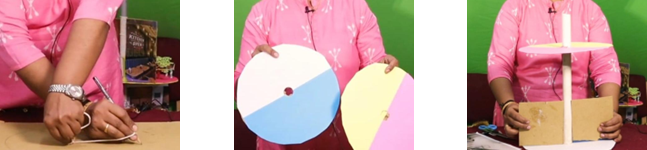
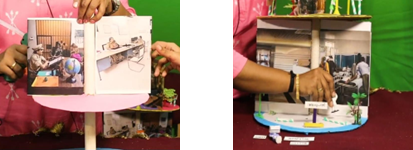
Important Tips
- This model will help children to remember and recall about the public places and professionals involved in each place.
- By using character models, children can remove and replace them. It will encourage them and strengthen awareness of public places. It further helps children to understand the roles and duties performed among different communities. Through this interactive way, they can learn more about daily life.
Using the Learning Teaching Material
The teachers can make this activity to teach children about everyday places.
Video: How to use Learning Teaching Material
| Source and Attribution of images All images used in the above Assets and Aids are originally created. |
| This content is jointly developed by Sri Sathya Sai Vidya Vahini Inclusive Education Project, a unit of Sri Sathya Sai Central Trust, Prashanthi Nilayam, and All India Institute of Speech and Hearing (AIISH) as an offering in the service of our nation, for the benefit of CWSN. |