
Identify Tree, Plant and Creepers
 Objective
 Objective
To help children understand and differentiate visually, between trees, plants and creepers through hands-on, interactive models.
Estimated time to create the model to identify tree, plant and creepers
1 to 1.5 hours for preparing each one of the tree, plant and creeper models
Materials required for creating the model to identify tree, plant and creepers
- For the tree model: (Apple tree) – card board, empty plastic water bottle, brown colour sheets, fevicol, cotton, scissors, printed images of leaves and fruits e.g. apple, orange, etc.
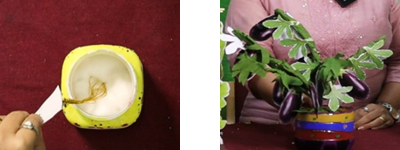
- For the plant model: (Brinjal plant) – reusable jar, sand for filling 3/4th of the jar, metal wires, green colour paper, cotton, scissors, pictures of brinjals and leaves.
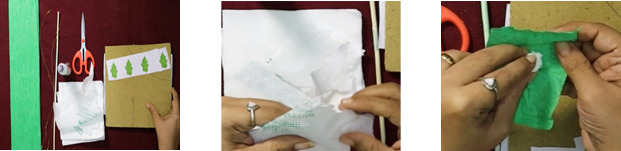
- For the creeper model: (Grape vine) – card board sheet, square or rectangular shaped thick thermocol plank (min 1ft x 1ft size) tissue papers, fevicol, long bamboo stick, metal wire, green colour paper, pictures of leaves, scissors.
Preparation for activity
- Collect all the materials required beforehand.
- Choose a base (cardboard or thermocol) for support and arrangement.
- Prepare pictures of fruits, vegetables and leaves in advance.
- Keep printed or drawn images ready for cutting and sticking.
- Allocate ample time for step-by-step construction.
Procedure
- A. Tree model
- Roll brown chart paper to make branches and trunk.
- Attach green leaves and red paper apples.
- Fix some cotton around the base and on the leaves to exhibit snowfall on trees.
- B. Plant model (e.g. Brinjal Plant)
- Twist the metal wire and cover it with green paper.
- Insert one end of the twisted wire into the reusable jar, filled with mud/sand. The other end of the wire should be protruding out of the jar.
- Use printed brinjal images and leaf cutouts.
- Attach them to sticks with glue or tape.
- Cotton filling can be used to give a more realistic look for the brinjal.
- C. Creeper model (e.g. Grapevine)
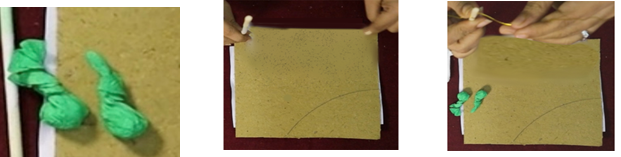
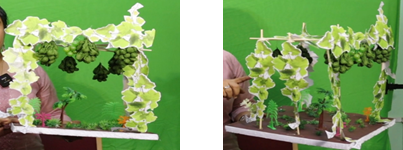
- Roll the tissue paper into small balls. Wrap it with a piece of green paper, to create the green grapes. Now, create grape bunches by combining multiple grapes.
- Make vine leaves using green colored paper or printed images.
- Fix one end of the sticks or straws as supports, in the corners of the thick thermocol base.
- Connect the top ends of the sticks using metal wire and hang the leaves and bunches of grapes.
Step by Step Pictures to create the Learning Teaching Material
A. Apple tree model
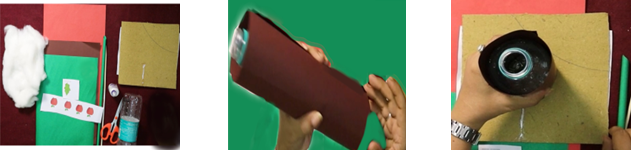
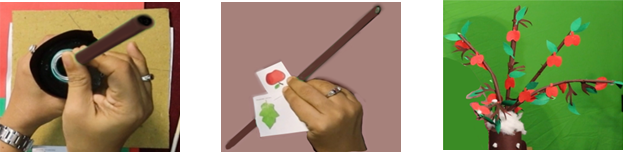
B. Brinjal plant model
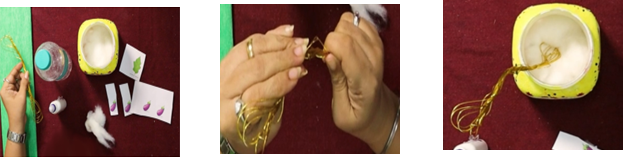
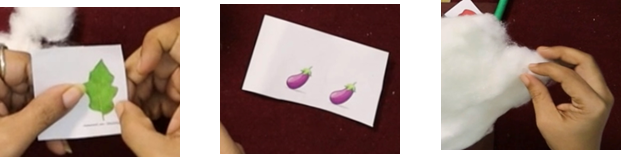
C. Grapes creeper model
Important Tips
- Pre-plan the model layout before assembling.
- Use bright, contrasting colors to grab children’s attention.
- Use lightweight materials to avoid tipping or breakage.
- Label all parts clearly.
- Involve students in preparation for interactive learning.
Precautions
- Supervise children when using scissors or glue.
- Avoid using fragile materials for structural parts.
- Ensure all parts are securely attached.
- Avoid cluttered or overloaded designs.
- Store the model safely to reuse multiple times.
Troubleshooting:
- If branches fall off, reinforce with tape.
- For unstable bases, add weight using stones or clay.
- If printouts peel off, use stronger glue or double-sided tape.
- To avoid colour fading, laminate or use coloured foam sheets.
- If the model bends or tilts, use sticks or skewers for support.
 Notes to the Teacher
- During the demonstration, relate each model to real plants that the children may have seen (e.g. mango tree, brinjal plant, grapevine).
- If possible, bring small real samples (like a leaf or fruit) to accompany the models.
- Emphasize the differences in structure i.e. strong trunks in trees, soft stems in creepers.
- Encourage students to touch and observe the models.
- Ask questions like, “Can you find the stem?” or “Which one is the tallest?”
- Let children sort leaves/ fruit pictures into correct plant types.
- Keep an extra set of printouts or parts in case something falls off or gets damaged during demonstration.
- Carry extra glue, tape or pins for quick fixes.
- Ensure there is enough space around you so all children can see the model clearly.
- Use a small stand or platform if you need height for better visibility.
- Post-demonstration you can ask the students to draw their favourite plant and write its type.
Using the Learning Teaching Material
Use these LTMs to explain types of plants – trees, shrubs, plants, creepers.
Encourage student participation in naming and identifying plant parts.
Integrate storytelling or songs to make it engaging for the children.
Use the model in quizzes or activities to reinforce learning.
Video: How to use Learning Teaching Material
| Source and Attribution of images All images used in the above Assets and Aids are originally created. |
| This content is jointly developed by Sri Sathya Sai Vidya Vahini Inclusive Education Project, a unit of Sri Sathya Sai Central Trust, Prashanthi Nilayam, and All India Institute of Speech and Hearing (AIISH) as an offering in the service of our nation, for the benefit of CWSN. |