Cow
 Objective
To guide teachers in creating a Cow Puppet for storytelling, classroom interaction and activity-based learning.
Estimated time to create the Cow Puppet
30 to 40 minutes
Materials required for creating the Cow Puppet
- White chart paper or thick A4 sheet
- Coloured chart paper (white, black, pink, brown)
- Black sketch pen
- Pencil
- Fevicol or glue drops
- Scissors
- Googly eyes (optional)
- Black wool or thread (optional – for tail and hair tuft)
Preparation for activity
- Keep all materials ready before beginning the activity.
- If using wool for the cow’s tail or tuft, cut small strands in advance.
- Ensure scissors are child-safe if children are involved in the puppet-making process.
- Have a clear workspace and collect waste bits neatly for easy clean-up.
Procedure
Hello everyone! Welcome to this fun and creative puppet-making activity. Today, we are going to make a cow Puppet that can be used for storytelling, rhymes and classroom activities.
- Step 1:
- Begin by drawing the different parts of the cow separately on the chart paper – the head, body, legs and tail. This helps in assembling the puppet with movable joints later. This is a rod puppet.
- Step 2:
On one half of the chart paper, draw the cow’s face and body. On the other half, draw four legs and a tail. Make sure the proportions match so the puppet looks balanced when assembled. - Step 3 (Optional):
- Label each part with a pencil-for example, front leg, hind leg, head, body – so that they are joined correctly after cutting.
- Step 4:
- Carefully cut out each part. Use a thick outline to guide cutting.
- Step 5:
- You can also draw patches or spots with a black sketch pen to make it more realistic.
- Step 6:
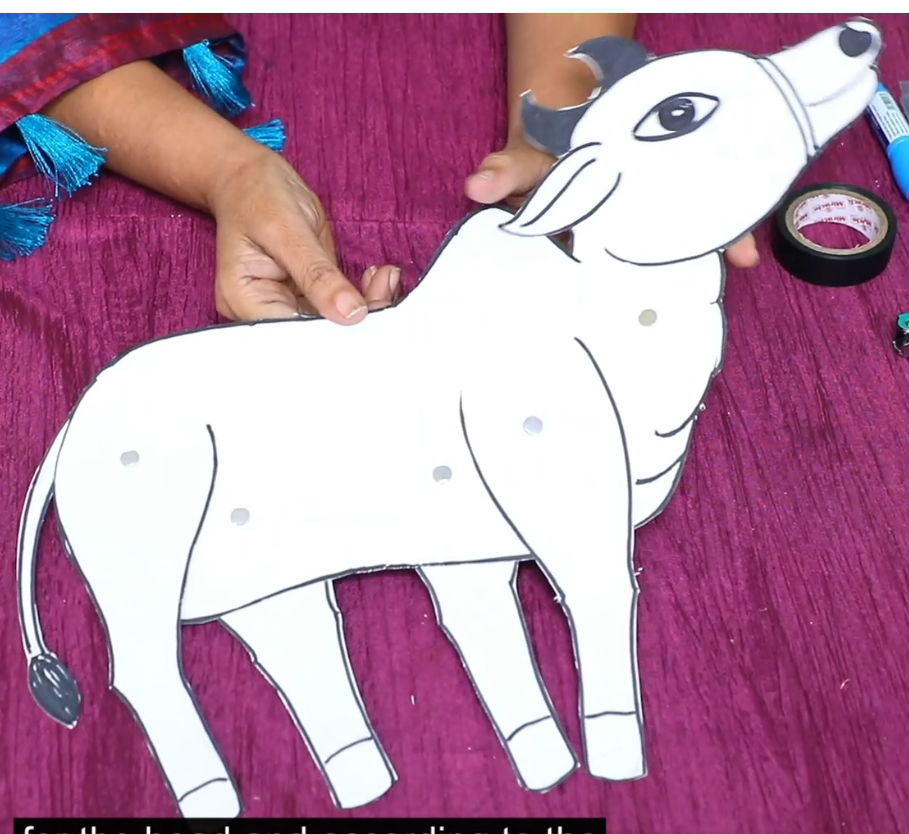
- Join the legs to the body and the head to the neck using glue or paper fasteners if movement is needed. Paste the tail at the back.
- Step 7:
- Stick googly eyes on the face or draw the eyes. Draw the nostrils and mouth neatly. Add wool for a tuft of hair if you wish.
- Step 8:
- Fix an ice-cream stick or straw behind the body of the cow for holding (Optional).
According to the context of what is being taught, different parts of the puppet can be moved during story-telling. For this puppet, we can attach ice-cream sticks or straw to all the four legs and the head to move them independently.
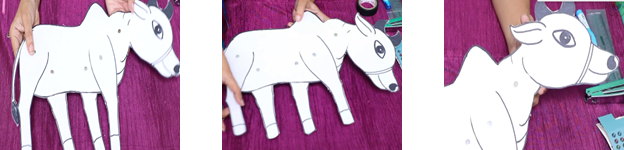
Step by Step Pictures to create the puppet
Important Tips
- Use thick chart sheets to make the puppet sturdy and reusable.
- Draw large and clear features so they are visible from a distance.
- If googly eyes are unavailable, draw them neatly with a sketch pen.
- Wedding cards or old covers can be reused for body parts.
- Add friendly features like a smile or colourful spots to make the puppet expressive.
Precautions
- Always use child-safe scissors when children are involved.
- Avoid excess glue – it can make the paper soggy.
- Allow enough drying time before handling the puppet.
- Keep the puppet facing the students during demonstrations.
- Use glue and scissors only under adult supervision.
Troubleshooting:
- Problem: Legs or tail do not stick firmly.
Solution: Apply glue only on the edges and press for a few seconds. Use thicker chart paper if necessary.
- Problem: Puppet bends or loses shape.
Solution: Reinforce the back with an extra layer of chart paper.
- Problem: Puppet does not move freely.
Solution: Check the joints; allow enough gap between parts for smooth movement.
- Problem: Colors fade or smudge.
Solution: Use crayons or sketch pens that do not bleed on paper.
 Notes to the Teacher
- Puppets are powerful Learning and Teaching Materials (LTMs) that make lessons more interactive and joyful.
- The Cow Puppet can be used across subjects and age groups.
- Encourage children to create their own puppets for group storytelling.
- Puppets promote creativity, communication and emotional expression.
- Personalise the puppet by adding a name tag like ‘Gauri the Cow’ to make it more relatable.
Different ways of using the Puppet in Class
Storytelling: Use the cow as a character in animal or moral stories.
Language Development: Create dialogues or rhymes involving the cow.
Value Education: Teach kindness, sharing and care for animals.
EVS: Integrate while teaching Farm Animals, Milk Products or My Home and Around.
Math Integration: Use counting or sequencing with farm animals.
Music and Rhymes: Pair with songs like: Old MacDonald Had a Farm.
Encourage children to perform short puppet shows or narrate their own animal tales using the cow puppet.
Video: How to use Learning Teaching Material
| Source and Attribution of images All images used in the above Assets and Aids are originally created. |
| This digital material has been developed by the Sri Sathya Sai Vidya Vahini Inclusive Education Project, a unit of Sri Sathya Sai Central Trust, Prasanthi Nilayam, as a collaborative offering in the service of our nation. |