Continuous Training and Development of Teachers and Other Stakeholders
Introduction
Starting an inclusive school is a significant step toward ensuring equal educational opportunities for all students, regardless of their abilities. However, to create an effective and truly inclusive learning environment, continuous training for all stakeholders, including administrators, teachers, support staff, non-teaching staff, and even parents, is essential.
Staff trainings help in fostering an understanding of diverse learning needs, and providing staff with skills and tools to support students effectively. Most importantly, ongoing trainings ensure that inclusive education becomes a sustainable and thriving practice.
5.1 Need for Continuous Sensitization, Training & Development
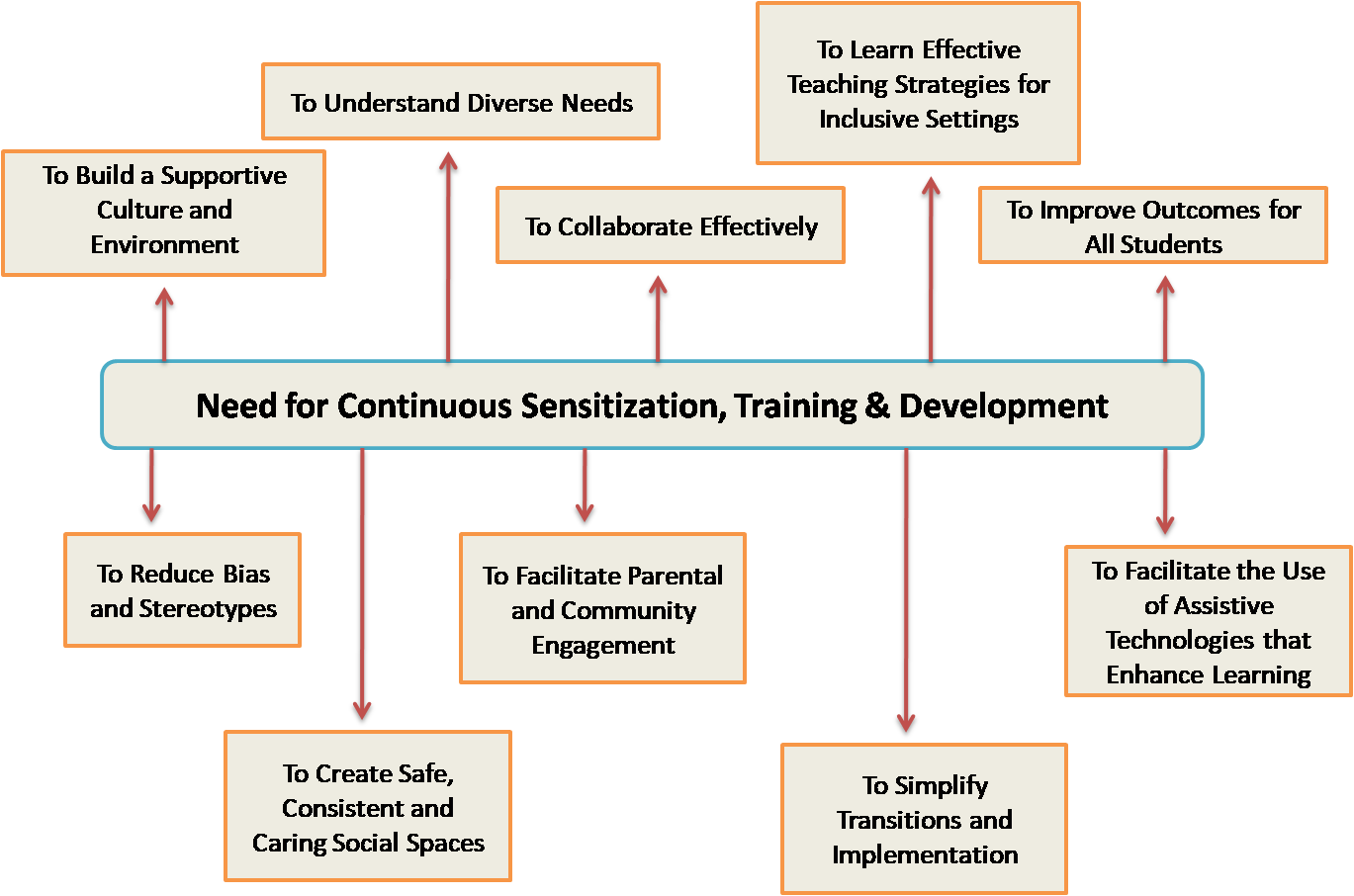
1. To Build a Supportive Culture and Environment– Inclusion works best when every staff member understands its importance and actively participates in creating an accepting environment. Training helps cultivate a school-wide mindset of respect, understanding, and collaboration. Every staff member plays a role in fostering a welcoming atmosphere where all students feel valued.
2. To Understand Diverse Needs – Students come with a range of abilities, learning styles, and social-emotional needs. Training ensures that staff can spot and address these differences effectively- whether it’s recognizing sensory sensitivities, understanding social communication challenges, or adapting teaching and communicating strategies.
3. To Collaborate Effectively – Inclusion requires teamwork among general education teachers, special education staff, administrators, and support personnel. Training fosters better collaboration and communication between these groups, ensuring that everyone understands their role in supporting students.
4. To Learn Effective Teaching Strategies for Inclusive Settings – Teachers and staff need to learn specific techniques such as differentiated instruction, universal design for learning (UDL), and positive behavior support strategies. Without training, educators may feel unprepared to effectively include students with diverse needs. The old methods of teaching, that mostly required students to listen and learn, may not address the unique needs of students.
5. To Reduce Bias and Stereotypes – Unconscious biases can at times impact how educators interact with students. Training helps staff recognize and address these unconscious biases, promoting a more equitable learning environment.
6. To Create Safe, Consistent and Caring Social Spaces– Beyond academics, inclusion also extends to recess, lunchrooms, hallways, playgrounds, libraries, laboratories and extracurricular activity rooms. Training ensures that all staff—including bus drivers, cafeteria workers, and librarians – understand how to foster inclusivity and prevent bullying or exclusion. When all staff understand inclusive practices, students receive consistent support in the classroom and all other spaces. The school team successfully creates a culture of care and inclusion.
7. To Facilitate Parental and Community Engagement – In a school system, stakeholders include anyone who impacts the life of the students of the school and is interested in their educational outcomes. A well-trained staff can better communicate with families, address concerns, and work collaboratively with parents, caregivers and the community to support student success.
8. To Simplify Transitions and Implementation – Change from the existing model to an inclusive school model can be challenging. Training provides staff with the confidence and skills needed to navigate the transition to an inclusive model effectively.
9. To Facilitate the Use of Assistive Technologies that Enhance Learning – Some digital technologies and assistive devices make learning easier and enjoyable for students with /without disabilities. Training is extremely essential to empower teachers and teaching assistants to be familiar with the various technologies and learning aids that a school chooses to use.
10. To Improve Outcomes for All Students – Inclusion benefits not only students with disabilities but all learners. Properly trained staff can adapt instruction, provide necessary accommodations, and support diverse learning styles. When teachers use inclusive strategies, they create a richer, more dynamic learning experiences that supports a variety of learning styles and needs.
5.1.1 How should the training be implemented?
The training for inclusive education should actually begin from the pre-service stage by effectively modifying the existing teacher-training curriculum. Although the present curriculum has ‘Inclusive Education’ as one of the topics, that does not prepare the teachers enough, to implement the same in the classroom. However, in-service trainings are equally important.
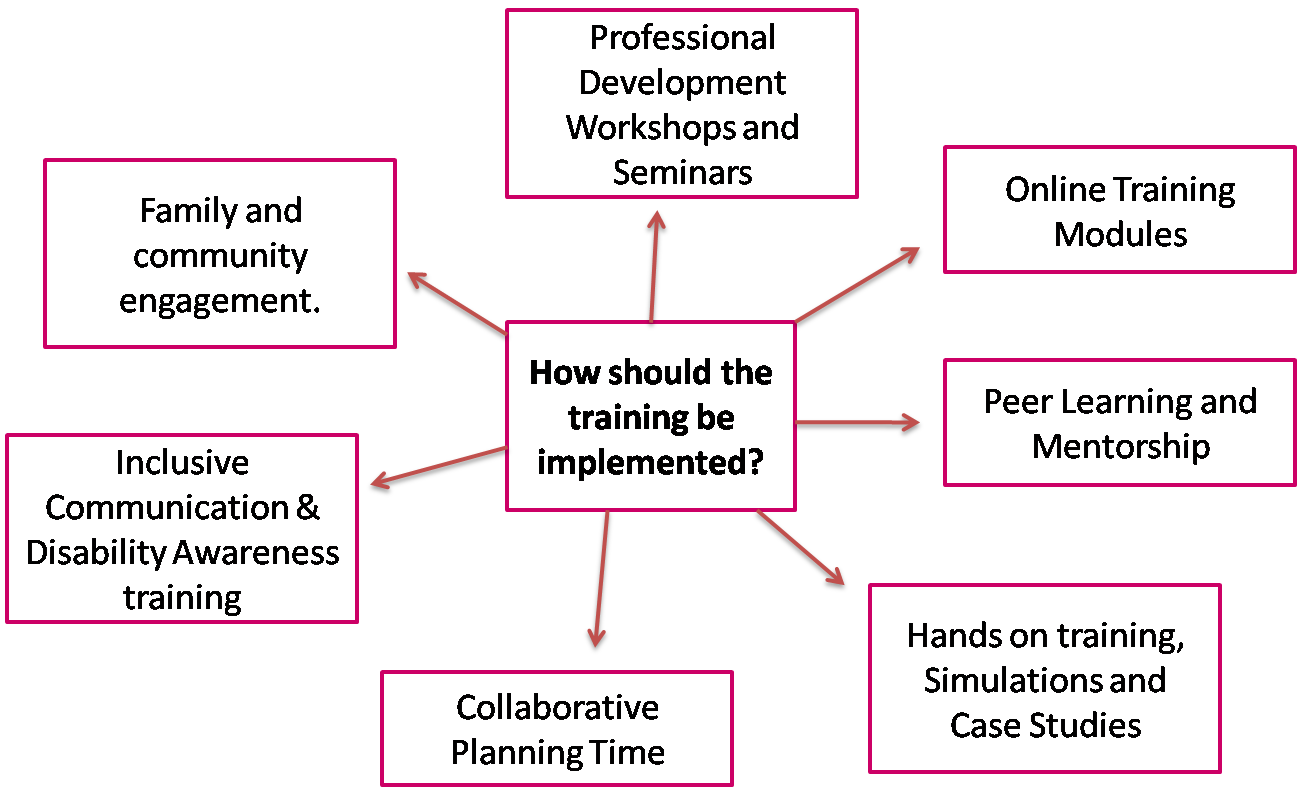
To ensure that all stakeholders receive adequate training, schools should adopt a variety of methods. They may include,
a) Professional Development Workshops and Seminars: Periodic in-person training sessions with experts in inclusive and special education. The subject or topic for these workshops may be chosen as per the needs felt by each school.
b) Online Training Modules: Flexible, self-paced courses that stakeholders can complete at their convenience.
c) Peer Learning and Mentorship: Pairing new staff members with experienced educators who have successfully implemented inclusive practices. Teachers observe experienced inclusive educators and receive feedback.
d) Hands on training, Simulations and Case Studies: Providing real-life scenarios to help staff develop problem-solving skills for handling challenges in an inclusive setting.Simulations are experiential activities that help staff understand sensory processing disorders, learning disabilities, or communication challenges (e.g., staff reads a book that is upside down, staff wears noise-canceling headphones to listen to someone talk, staff try to move around blind-folded).
e) Collaborative Planning Time: Organizing regular team meetings of special educators, general educators, and support staff to discuss student progress and strategies. Staff collaborate on inclusive practices and problem-solve together by forming effective Professional Learning Communities (PLCs).
f) Inclusive Communication & Disability Awareness training:
- Training for All staff to ensure that office staff, canteen workers, bus drivers & conductors, librarians, coaches and all other stakeholders understand inclusive practices and how to interact respectfully and empathetically with students with disabilities.
- Guest Speakers & Advocacy Groups that are actually working with CWSN are invited to share their experiences and best practices.
g) Family & Community Engagement:
- Parent Workshops to help families understand inclusion and provide resources for supporting learning at home.
- Community Partnerships to work with local disability organizations, special schools, vocational centers etc. to bring in expertise and resources.
5.1.2 When Should Training Sessions Take Place?
1. Before the School Year Starts – Initial training should occur before students arrive to prepare staff with foundational knowledge.
2. Ongoing Throughout the Year – Regular training sessions ensure staff stay updated on best practices, new technologies, and evolving student needs.
3. During Staff Meetings – Brief training segments in meetings keep inclusive education at the forefront.
4. After Identifying Specific Challenges – If staff encounter new challenges, targeted training should be provided promptly.
5. As Part of Professional Development Days – Dedicated time or specific days should be set aside in the academic calendar, for deep-dive training sessions and skill enhancement.
6. When New Staff Join – New hires should receive immediate training to align with the school’s inclusive philosophy.
5.2 Why is training for teachers most important?
“The twenty-first century competences and skills are basic requirements for all of us including teachers, head teachers, teacher educators and other stakeholders in the present rapidly changing world. The National Education Policy 2020 emphasizes that the teacher has to be brought to the center of fundamental reforms in education. Thus, teachers assume the central place in the entire scheme of learning process. Consequently, an increased importance has been placed on the necessity for the professional development of teachers and other concerned stakeholders in order to bring a qualitative change in the education system.”
(Excerpts from ‘Guidelines for 50 Hours of Continuous Professional Development for Teachers, Head Teachers and Teacher Educators – Based on National Education Policy 2020’ Published by NCERT)
Teachers are the core human resource for the implementation of inclusive education. They do need to be equipped with a set of pedagogical practices to include all children in the teaching and learning processes. Their knowledge, competencies and attitudes are directly correlated with students’ learning outcomes. But what is most important and above everything else, is the teacher’s attitude and the relationship he/she shares with the students.
To build an inclusive education system an inclusive teacher is as important as an inclusive school. Resistance from teachers and their lack of readiness to inclusion is a great barrier to inclusion that can impede all the efforts, policies and practices concerning inclusion. Teachers play a pivotal role in achieving goals of inclusive education.
Teachers also serve as facilitators of peer interactions, ensuring that students with and without disabilities engage positively. Moreover, they need to collaborate with special educators, therapists, and parents to develop strategies for student success. To effectively fulfill these roles, teachers must undergo continuous training to upgrade their skills in teaching, behavior management, and assistive technology. Ongoing professional development will help teachers remain updated with best practices in inclusive education.
Government platforms like DIKSHA and SWAYAM, provide free, bilingual, and curriculum-aligned professional development courses. These, along with specialized programs from NCERT, CBSE, and the British Council, support competency-based education and digital pedagogical skills aligned with NEP 2020 standards.
5.3 Areas for training and empowerment for teachers:
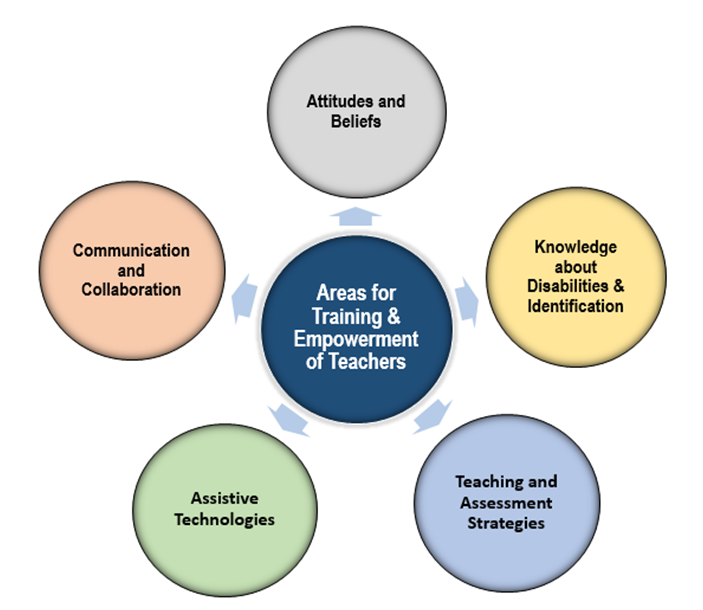
5.3.1 Attitudes and Beliefs:
As inclusive education stems from the philosophy of inclusion, it is crucial that school authorities address the following needs:
- Sensitizing teachers about what is inclusion and the principles of inclusion such as social justice, equity, acceptance, individual differences and strengths.
- Transforming teachers’ beliefs, attitudes, misconceptions, and prejudices related to the education of students with disabilities and inclusive education.
- Developing expansive feeling, inclusive thinking, and intuitive vision in the teachers in order to bring about inclusion effectively.
- Enabling teachers to understand ‘The power of Relationships’ for true inclusion in schools.’ It is not the qualification, the expertise, the training or the knowledge. It is the bond or connection that the teacher establishes with a child that makes him or her want to learn. This is true even for children with special needs because the child is a child first before anything else.
Some Training Resources:
- Inclusion 101: Overview of inclusive education principles and the benefits of inclusion for all students.
- IRIS Center (Vanderbilt University): Free, evidence-based training modules on inclusion and special education.
- National Association of Elementary School Principals (NAESP) – Leadership in inclusive schools.
4.3.2 Basic knowledge about disabilities and their identification:
- To solve any problem early identification is a pre-requisite. Therefore, making teachers aware of children with special needs (CWSN) – about the nature of disabilities and approaches for addressing their special learning needs, is essential.
- An inclusive school allows all children to access school and the primary focus is on the student’s capabilities and strengths and not on the specific diagnosis. Therefore, schools have to ensure that teachers are oriented in assessing the strengths of the learners and in detecting early signs of difficulty, without rushing to label a child.
- It is also necessary to make teachers familiar with the use of a variety of tools, techniques, check lists and resources that are available for initial screening of children. ‘PRASHAST’ is the new tool that NCERT has brought out for this purpose.
Key training areas and resources
- Ongoing training workshops on disability awareness and strategies.
- Training for ‘Careful observation and screening of children with disabilities’.
- Training to use the tool- ‘PRASHAST’ of NCERT (DSCS booklet)
5.3.3 Effective teaching strategies for an inclusive classroom
- Teachers have to be provided with continuous professional development opportunities in the latest pedagogies and teaching techniques like UDL, differentiated instruction and multiple intelligence theory.
- Empowering and motivating teachers to use multidisciplinary and multisensory approaches along with innovative and child-centered teaching strategies will contribute a great deal to the overall success of the school’s Inclusive education program.
- Such trainings will also make teachers aware of the need and the ways to adapt curriculum, modify instructional and assessment strategies to suit an inclusive classroom.
Key training areas and resources
- Differentiated Instruction & UDL: Learn to modify lesson plans to meet diverse learning needs.
- CAST UDL Guidelines – Universal Design for Learning strategies
- Council for Exceptional Children (CEC) – Inclusive teaching strategies
- Co-Teaching Models like parallel teaching, station teaching, and team teaching.
- Collaboration of general and special education teachers
- Positive Behavioral Support & Classroom Management: PBIS ((Positive Behavioral Interventions & Supports), de-escalation techniques, and fostering a positive learning environment.
- Effective use of art-integrated, play-integrated, story-integrated pedagogies.
- Creating stage appropriate Teaching Learning Aids & Materials
Video:
4.3.4 Use of Assistive Technology and AI in teaching
In an inclusive classroom, the integration of Assistive Devices and Artificial Intelligence (AI) acts as a powerful equalizer for Children with Special Needs (CWSN), transforming potential barriers into pathways for success. Traditional assistive technologies—such as Braille displays, hearing aids, and adaptive keyboards—provide the fundamental physical and sensory access required for participation.
When bolstered by AI, these tools become dynamic and “smart,” offering personalized scaffolding that adapts to a student’s unique learning pace in real-time. For instance, AI-driven speech-to-text software allows students with motor or speech impairments to communicate their ideas fluently, while predictive text and automated task-breakdown tools support those with executive function challenges. By shifting the focus from “fitting the child to the system” to “adapting the environment to the child,” these technologies foster independence, boost self-esteem, and ensure that every learner can engage meaningfully with the curriculum alongside their peers.
Therefore, training teachers in the use of assistive devices and Artificial Intelligence effectively has become the need of the hour.
Training Resource: There are numerous courses available. One of them is on
Swayam plus+ – A course called “AI for Educators”
5.3.5 Communication and collaboration
Communication and collaboration are the abilities to exchange information, ideas and feedback in order to work together towards a common goal.
A good learning environment is characterized by safety, respect, inclusion, support, communication and collaboration. By modelling positive behavior, valuing diversity, celebrating differences, providing support and practicing effective communication and collaboration, teachers can motivate children to imbibe these qualities and thereby enrich the school environment.
In an Inclusive set up, teachers need to interact and work with general education teachers, special education teachers, school counsellors, therapists, sports coaches, vocational trainers, non-teaching staff, parents and students with or without disabilities.
All teachers need training and support to hone their communication and collaboration skills to carry out the tasks entrusted to them effectively. Effective communication and collaboration results in good teamwork and without teamwork true Inclusion cannot happen.
5.4 Training Non-teaching staff and other stakeholders in school
An inclusive environment is one of shared responsibility of all stakeholders. Normally many Schools divide responsibilities between general education teachers, special education teachers, counsellors, and others. Inclusion requires that all staff take responsibility for all students.
Apart from the teachers (academic, physical education, extracurricular) with whom the students interact closely in a school, there are various stakeholders in an inclusive school with whom the children interact daily. They include Office staff /Admin, Security, Helpers/ Utility staff, Cleaners, Canteen staff, Bus drivers, Helpers, and Visitors.
- The above personnel of the school must be made aware about the school’s policies on Inclusion and trained/sensitized on the various aspects that will affect their interaction with the CWSN (Child with Special Need).
- There must be an introductory meeting at the beginning of every academic session, initiated by the head of the school with different categories of non-teaching staff, explaining the policies of Inclusion and the expectations from various staff.
- These meetings in every school will be need based and specific to the children in each school.
- If required, such meetings should be organized in the local language that is used most commonly by the respective team of staff members.
- It is very important to make all stakeholders understand the ‘do’s and don’ts’ of interacting with children or adults with disabilities.
- Regular incentives/appreciation of work undertaken by the staff especially with respect to CWSN will keep the staff motivated to do their duty in appropriate ways.
- Periodic experience sharing about the Special needs children between the teaching and non-teaching staff will help in creating a truly inclusive school for the child.
1. Sports, Vocational & Extra-curricular Activities teachers:
Key training areas
- Development and implementation of inclusive programs that cater to students with diverse abilities and interests.
- Offering a variety of activities that can be adapted to accommodate different skill levels and disabilities.
- Implementing adaptations or modifications in events. This may include modifying rules, equipment, or techniques to ensure equal participation and meaningful engagement.
- Ensuring that sports equipment, facilities, and training areas are accessible and inclusive for all students.
- Encouraging peer involvement and teamwork among students with and without disabilities. Thus, fostering an inclusive environment where students learn from each other, support one another, and develop social skills through collaborative sports and vocational activities.
- Prioritizing the safety and well-being of all students during sports and vocational training sessions. Adhering to safety protocols, providing appropriate supervision, and ensuring that students are using equipment and facilities correctly to prevent injuries.
- Recognizing and celebrating the achievements of students with disabilities in sports, vocational training and other activities. Emphasizing effort, progress, and personal growth rather than solely focusing on competition or outcomes. (To know more, please go to Enabler-8 in this vertical.)
2. Shadow Teachers & Helper teachers:
Key Training Areas:
- Supporting Student Independence: Encouraging students to develop self-advocacy and problem-solving skills rather than doing tasks for them.
- Understanding Disabilities & Sensory Needs: Basics of autism, ADHD, dyslexia, and other learning differences.
- Assisting with Communication: Using AAC (Augmentative and Alternative Communication) tools for nonverbal students.
- Behavioral Support & De-Escalation Techniques: How to calmly address challenging behaviors and reinforce positive actions.
Training Resources:
- “Paraeducator Training” (IRIS Center) – Free online courses
- The National Resource Center for Paraeducators
3. School Counselors & the School Wellness team
Key Training Areas:
- Social-Emotional Learning & Peer Inclusion: Teaching self-advocacy and social skills to students with disabilities.
- Mental Health & Disability Intersection: Understanding how conditions like autism, anxiety, and ADHD impact social-emotional development.
- Bullying Prevention & Peer Education: Strategies for creating an inclusive and accepting school climate.
Training Resources:
- Collaborative for Academic, Social, and Emotional Learning (CASEL) – SEL training
- PBIS (Positive Behavioral Interventions & Supports) Resources
4. Support Staff, Transport staff, Security staff, librarians & laboratory assistants, Office Staff
Key Training Areas:
- Disability Awareness & Respectful Communication: Understanding the importance of inclusion beyond the classroom.
- Behavioral and Safety Considerations: How to support students who may have sensory processing challenges or mobility needs.
- Emergency & Crisis Planning: Ensuring staff know how to assist students with disabilities in drills and emergencies.
Training Resources:
- National Association for Pupil Transportation (NAPT) – Special needs transportation training
- Disability Awareness Training Programs (local disability organizations)
5. Parents , Siblings and Classmates
In a school system, stakeholders include anyone who impacts the life of the students of the school and is interested in their educational outcomes. Therefore, it goes without saying that parents, siblings and classmates are very important stakeholders and they have to be a part of the school’s programme for inclusive education. Effective sensitization and need based training sessions are necessary for them to be empathetic, compassionate and empowered influencers in the lives of children with special needs. (Considering the significance of their roles, we have a dedicated section spelling out the guidelines in this area in Enabler No.10 of this vertical)
Conclusion:
Raising consciousness among stakeholders in inclusive education and social justice involves creating awareness, fostering empathy, and promoting a deep understanding of the importance of inclusivity and justice in educational settings.
Education leaders/School Managements should take responsibility for training and development in the schools and institutions that they lead. Keeping in mind the children entrusted to us, we must continuously assess the gaps in our school systems and environment and address these gaps through training sessions that are integrated into the annual school calendar. Investing in ongoing continuous training and development program will ultimately lead to better educational outcomes for all students and create a culture of inclusivity and acceptance. A blended approach, with a combination of online and offline modules would be more effective.
Inclusion is not just about students with disabilities—it’s about creating a school-wide culture that values diversity, equity, and accessibility for all learners. We must remember that professional development programs are needed for both the experienced and the novice (beginner) because they not only provide opportunities for new learning, exploration, growth and development, but also promote the recognition of hard work that experienced people do under demanding conditions. Thus, professional development of all stakeholders can be understood as a lifelong learning process, which starts with the pre-service and continues until retirement from service.
Video:
Resource Document: Continuous Training and Development of Teachers and Other Stakeholders
| Source and Attribution of images All images used in the above Assets and Aids are originally created. |
| This digital material has been developed by the Sri Sathya Sai Vidya Vahini Inclusive Education Project, a unit of Sri Sathya Sai Central Trust, Prasanthi Nilayam, as a collaborative offering in the service of our nation. |