Multiplication Facts
Week 1 & 2 – Multiplication Facts – 2, 5, 10
Learning Outcome
Performs multiplication problems fluently using skip counting.
 Objective
 Objective
Students will be able to understand and represent multiplication facts by writing number sentences and drawing models.
Students will be able to use skip counting strategies to accurately find and write multiplication answers.
Prerequisites
 Prerequisites
Children
- can skip count
- addition skills
 Pre-teach Vocabulary
 Pre-teach Vocabulary
Children should be familiar with the terms such as, groups, equal, unequal, same, different, count, arrange, and pattern.
Introduction: Building Multiplication Facts of 2, 5 and 10
Material required:
- Times Table Chart with part whole model
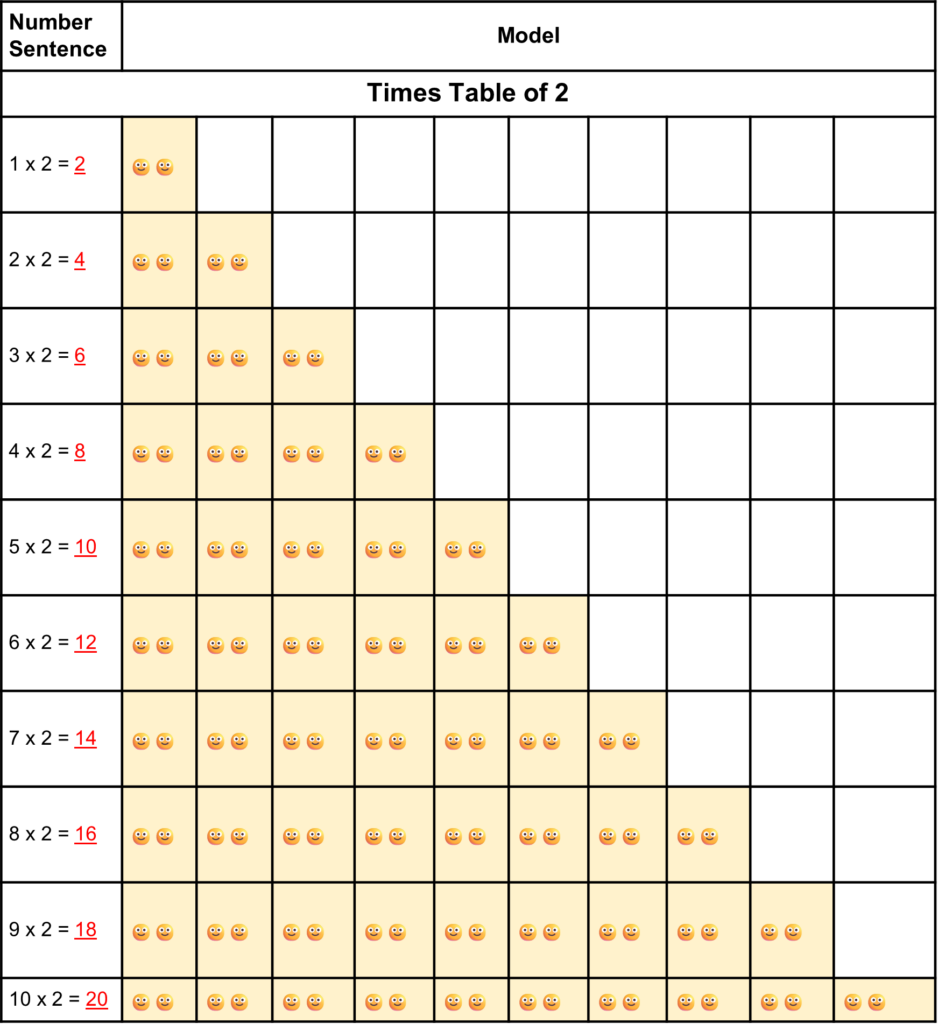
The teacher can begin the lesson by showing the children a Times table chart.
Teaching Method: I Do – We Do – You Do
I Do (Teacher Modelling):
The teacher starts the class by announcing, Today, we are going to learn how to build tables by –
- Writing the number sentence.
- Drawing a model for the number sentence.
- Use skip counting to write the answer.
The teacher shows the times table chart and lets the children know that we are going to build 2 times table on this chart. The teacher writes 2 in the blank given
Step 1: Write the number sentence – 1 x 2 = ____
Step 2: Draw the model for the number sentence- Draw two dots in the first column.
Step 3: Skip count (Not needed for 1 x 2)
Step 4: Fill in the blank (1 x 2 = 2 )
Let’s move to the next row and follow the same steps.
Step 1: Write the number sentence – 2 x 2 = ____
Step 2: Draw the model for the number sentence- Draw two dots in the first column and two in the second column.
Step 3: Skip count (2, 4)
Step 4: Fill in the blank (2 x 2 = 4 )
(The teacher builds the times table of 2 following the above steps.)
Step 1: Write the number sentence – 3 x 2 = ____
Step 2: Draw the model for the number sentence- Draw two dots in the first column, two in the second column and two in the third column.
Step 3: Skip count (2, 4, 6)
Step 4: Fill in the blank (3 x 2 = 6 )
Step 1: Write the number sentence – 4 x 2 = ____
Step 2: Draw the model for the number sentence- Draw two dots in the first column, two in the second column, two in the third column and two in the fourth column
Step 3: Skip count (2, 4, 6, 8)
Step 4: Fill in the blank (4 x 2 = 8 )
 Note to the teacher:
Continue building the 2 times table till you reach 10 x 2 = 20
Note to the teacher:
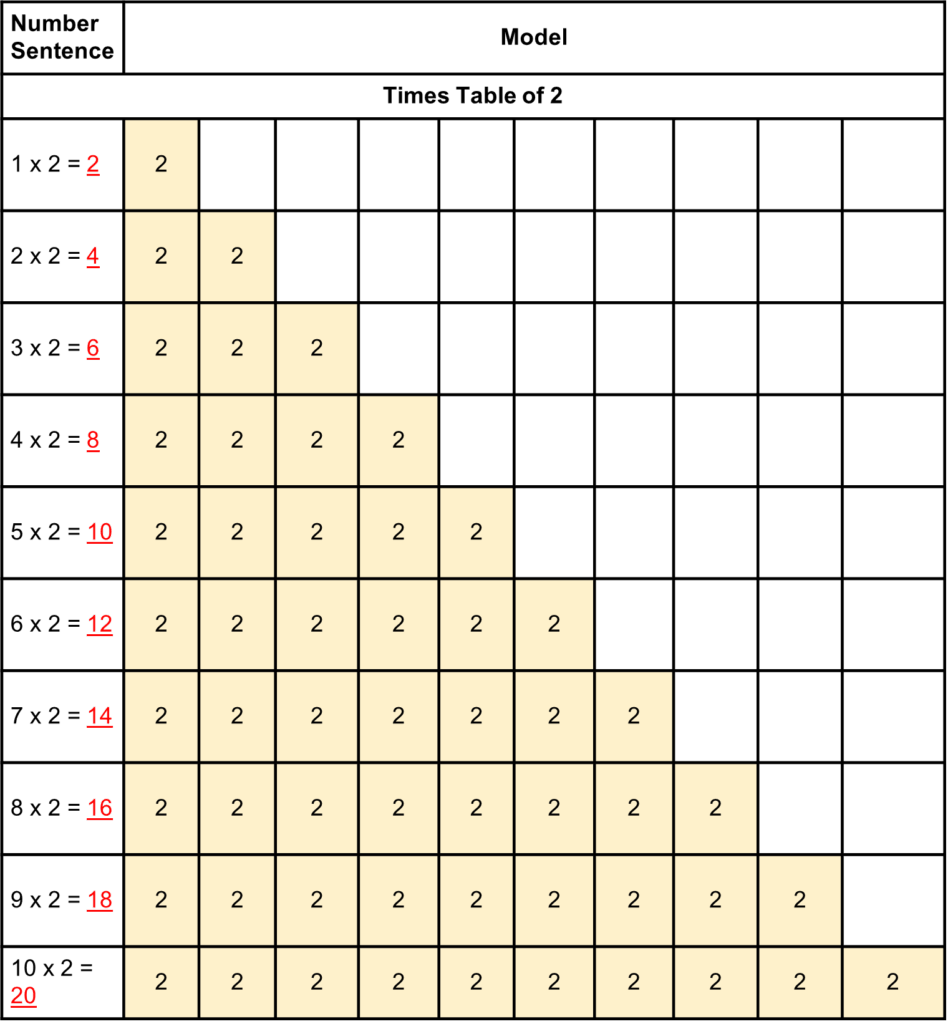
If children find it challenging to draw in the columns they can represent by writing the number (2 in each column)
We Do (Guided practice):
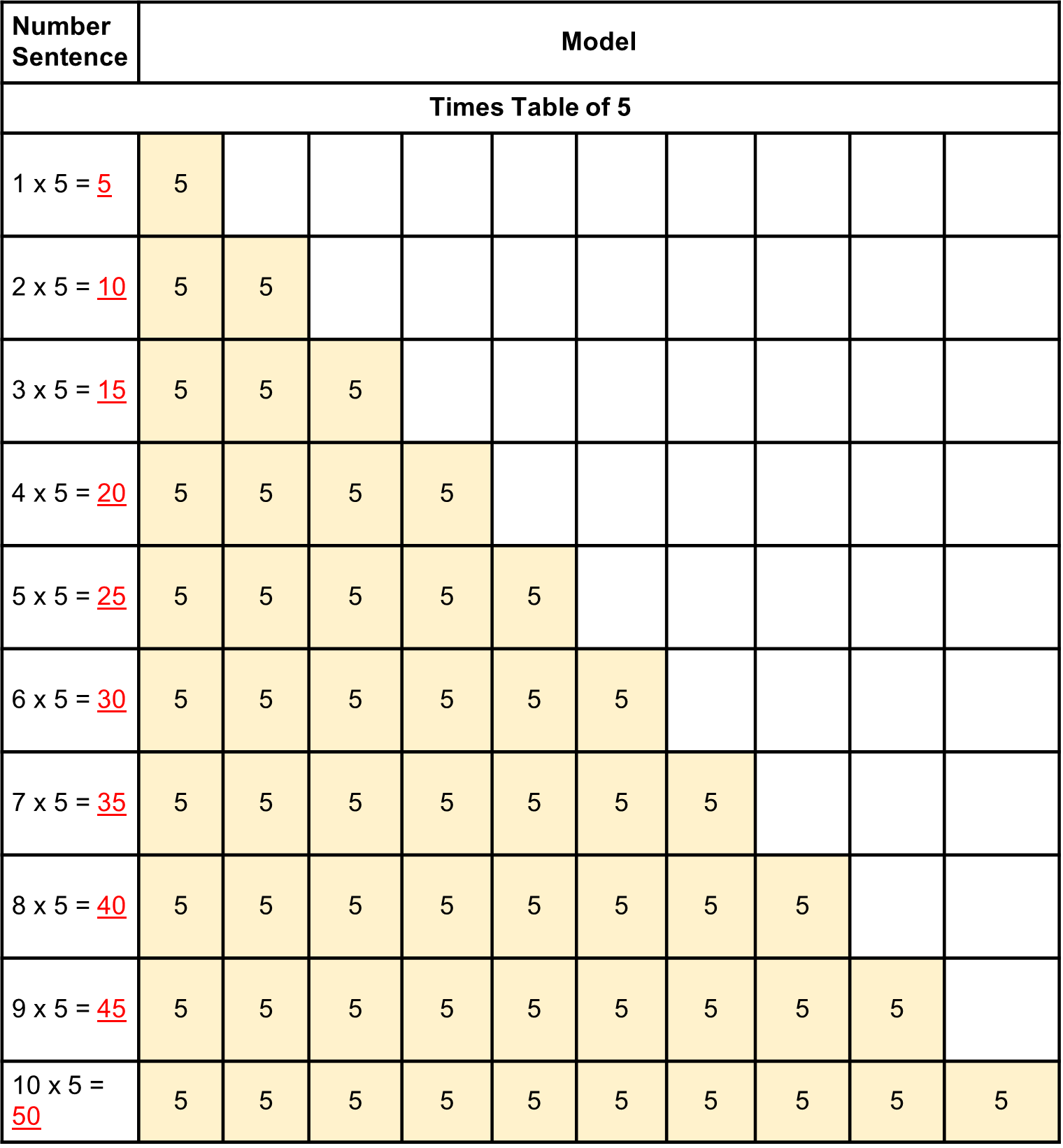
Let us now build the 5 times table together using the times table chart.
The teacher does the work together with the children. Each child is given a blank Times table sheet to build the table of 5. Follow the same steps:
- Writing the number sentence.
- Drawing a model for the number sentence.
- Use skip counting to write the answer.
We Do (Independent Practice):
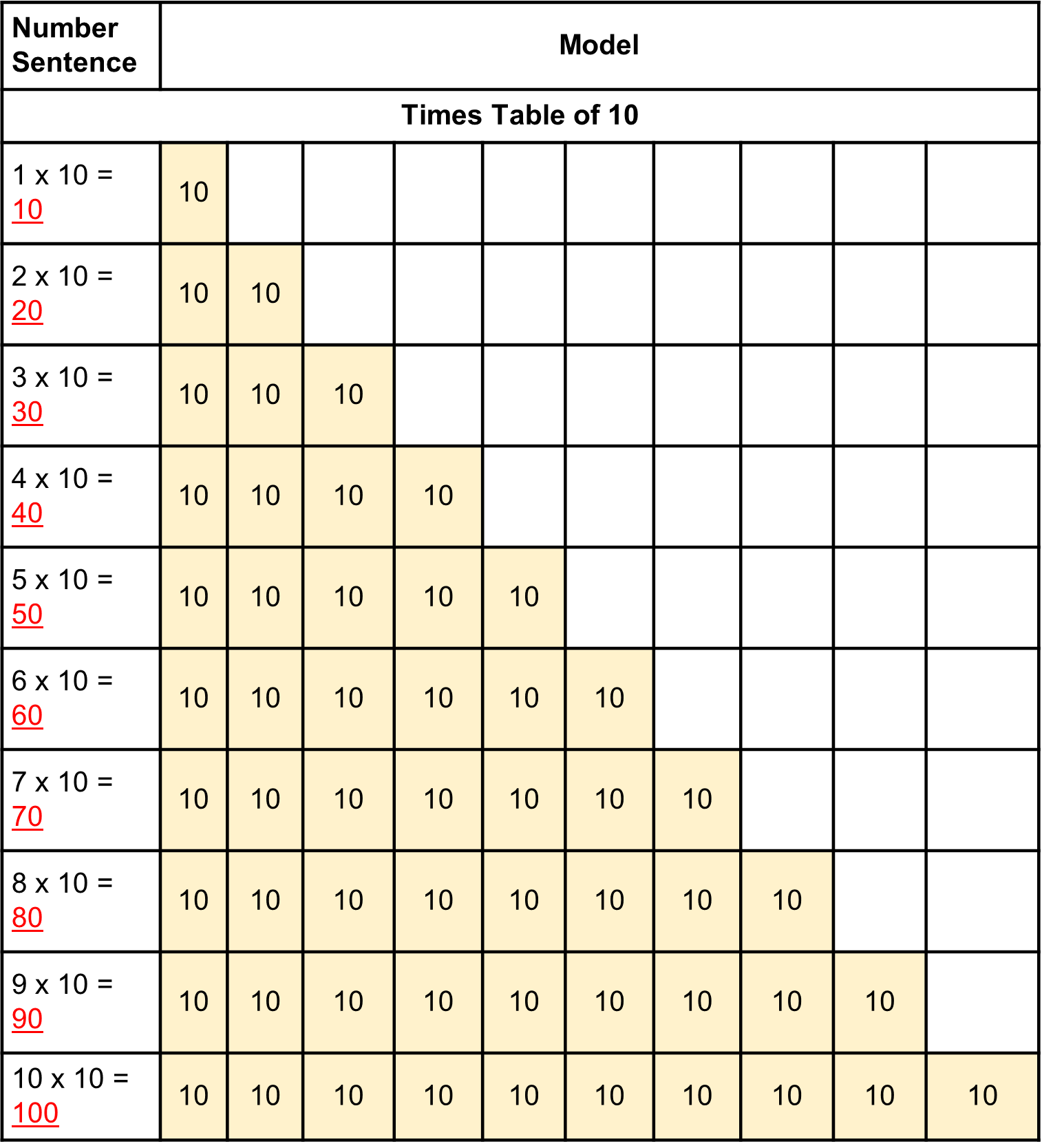
Children work individually or in pairs and build the Times table of 10
Refer to ‘Sequencing skills’ Adaptations and Strategies given in the Main page of ‘Multiplication Facts’ if there are any neuro-diverse children in the class.
Video: Build Times table of 2 – Coming soon
ISL Video: Build Times table of 2 – Coming soon
LTM: Worksheet Template Times Table – Coming soon
LTM: Printed money and coins – 1, 2, 5 and 10 – Coming soon
LTM: Task cards for Matching Activity – Coming soon
LTM: Multiplication Table Chart 2, 5 and 10 – Coming soon
Activity 1: Build Times Table with Money
Objective:
Students will be able to build and write tables of 2, 5, and 10 using skip counting.
Importance of the activity:
- Connects mathematics with real-life situations (handling money).
- Helps in conceptual understanding of multiplication through concrete materials.
- Enhances problem-solving and reasoning skills.
- Makes learning engaging and meaningful.
Resources required:
- Play coins/notes (₹1, ₹2, ₹5, ₹10)
- Paper plates or small bowls
- Worksheets (optional)
- Chart paper and marker
Setting for the activity:
- Classroom setting (students seated in small groups or circles)
- Can also be done on the floor for better interaction
Type of activity: Group activity
Preparation of activity:
- Arrange students into small groups (3–4 students each).
- Distribute play money and containers to each group.
- Keep demonstration materials ready.
- Prepare guiding questions and examples.
Role of the teacher:
Demonstrator:
- Show how to group coins (e.g., 2 coins in each group for table of 2).
- Model writing number sentences (3 × 2 = 6).
Observer:
- Monitor students while they perform the activity.
- Check if students are grouping correctly and skip counting accurately.
Facilitator.
- Guide students with questions like: “How many groups?” “How much money in total?”
- Support students who need help.
- Encourage discussion within groups.
Procedure:
- Begin with a discussion about money and its use.
- Demonstrate grouping coins for table of 2 (e.g., 2 coins in each group).
- Ask students to make 1 group, 2 groups, 3 groups, and so on.
- Students count total coins using skip counting (2, 4, 6, 8…).
- Write number sentences for each (e.g., 3 × 2 = 6).
- Repeat the activity for tables of 5 and 10 using ₹5 and ₹10 coins/notes.
- Encourage students to draw models of their groups in the Times table sheet.
- Discuss answers as a class.
Observation by teacher:
- Students’ ability to form equal groups.
- Accuracy in skip counting.
- Understanding of number sentences.
- Participation and collaboration in groups.
Conclusion:
- Reinforce that multiplication is repeated addition.
- Highlight how skip counting helps in quick calculations.
- Recap tables of 2, 5, and 10 using student responses.
- Encourage students to relate learning to real-life money use
Refer to ‘Organisational skills’ Adaptations and Strategies given in the Main page of ‘Multiplication Facts’ if there are any neuro-diverse children in the class.
Video: Build times tables using money – Coming soon
ISL Video: Build times tables using money – Coming soon
Activity 2: Task Cards – Match the picture card with the Multiplication Sentence
Objective:
- Students will be able to match multiplication sentences with correct pictorial representations.
- Students will understand multiplication as repeated addition using groups of 2, 5, and 10.
Importance of the activity:
- Strengthens conceptual understanding of multiplication.
- Helps students connect visual models with number sentences.
- Enhances observation, thinking, and matching skills.
- Makes learning interactive and engaging.
Resources required:
- Task cards with multiplication sentences
- Picture cards showing equal groups
- Envelopes or rubber bands to organize sets
- Worksheet (optional for follow-up)
Teaching Learning Materials Required (TLMs):
- Flashcards (2, 5, 10 tables)
- Picture cards (apples, stars, balls, etc.)
- Chart paper for demonstration
- Blackboard/whiteboard
Setting for the activity:
- Classroom setting with students seated in small groups
- Can be done on desks or on the floor for easy movement
Type of activity:
Group activity / Pair activity
Preparation of activity:
- Prepare 20 multiplication sentence cards (2, 5, 10 tables).
- Prepare corresponding 20 picture cards showing equal groups.
- Shuffle and mix both sets separately.
- Ensure pictures clearly show grouping (e.g., circles or rows).
Role of the teacher:
Demonstrator:
- Show one example of matching (e.g., 2 × 10 with 2 groups of 10 objects each).
- Explain how to observe groups and count.
Observer:
- Monitor students while they match cards.
- Check for correct grouping and understanding.
Facilitator:
- Guide students with prompts like “How many groups?” “How many in each group?”
- Support students and encourage discussion.
Procedure:
- Begin with a quick revision of tables of 2, 5, and 10 using skip counting.
- Show a sample multiplication card and its matching picture card.
- Divide students into small groups or pairs.
- Distribute mixed sets of multiplication and picture cards to each group.
- Ask students to match each multiplication sentence with the correct picture.
- Students discuss within groups and justify their matches.
- Once completed, the teacher reviews answers with the class.
- Encourage students to explain their reasoning.
Observation by teacher:
- Students’ ability to identify equal groups.
- Accuracy in matching multiplication sentences.
- Use of skip counting or repeated addition.
- Participation and teamwork.
Conclusion:
- Reinforce that multiplication represents equal groups.
- Summarize how pictures help in understanding number sentences.
- Recap tables of 2, 5, and 10 through oral questioning.
- Appreciate students’ participation and effort.
Refer to ‘Attention and Focus’ Adaptations and Strategies given in the Main page of ‘Multiplication Facts’ if there are any neuro-diverse children in the class.
Refer to ‘Receptive and Expressive Language skills’ Adaptations and Strategies given in the Main page of ‘Multiplication Facts’ if there are any neuro-diverse children in the class.
Assessment
The teacher can give the practice worksheet to children which can be followed by an assessment worksheet.
Practice Worksheet – Coming soon
Practice Worksheet (Enlarged) – Coming soon
Assessment Worksheet – Coming soon
Assessment Worksheet (Enlarged) – Coming soon
Cross-Curricular Connection:
- Art Class:
Children can create patterns of 2, 5 or 10 groups using different shapes or colours (e.g., 2 groups of 4 triangles). - Language Class:
Children write simple sentences describing equal groups they observe in the classroom or in pictures.
Check list for teacher:
| Activity | Yes | No | Sometimes |
| Children can: | |||
| Group objects correctly (in 2s, 5s, and 10s) | |||
| Write correct multiplication sentences | |||
| Use skip counting to find answers | |||
| Build and recall tables of 2, 10, and 10 | |||
| Draw models to represent multiplication facts | |||
| Apply multiplication facts in simple real-life situations |
Home Activity
Times Table worksheet for practice can be given to students.
Teacher Resource Document – Coming soon
| Source and Attribution of images: All images used in the above Assets and Aids are originally created. |
| This digital material has been developed by the Sri Sathya Sai Vidya Vahini Inclusive Education Project, a unit of Sri Sathya Sai Central Trust, Prasanthi Nilayam, as a collaborative offering in the service of our nation. |