Demo on ‘How to draw’ for a Boy Puppet
 Objective
 Objective
To guide teachers in creating a drawing for a Boy Puppet that can be used for storytelling, classroom interaction and activity-based learning.
Estimated time to create the drawing for the puppet
30 to 40 minutes
Materials required to create the drawing for the puppet
- White chart paper or A4 sheet (hard)
- Coloured chart paper (skin shade, shirt colour, trouser colour)
- Black sketch pen
- Pencil
- Fevicol or glue drops
- Scissors
- Black wool (optional – for hair)
- Googly eyes (optional)
Preparation for activity
- Keep all materials ready before beginning the activity.
- If using wool for hair, cut small strands in advance to save time.
- Ensure scissors are child-safe if children are involved in the puppet making process
Procedure
- Step 1:
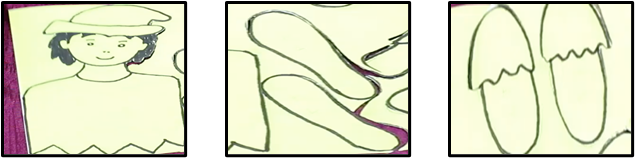
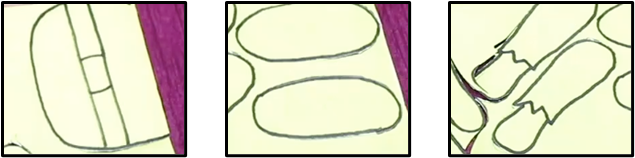
To make the puppet, (any puppet) we need to know the different parts and move them separately. For example – upper hand, lower hand, upper leg, lower leg. We need to draw these parts separately and then assemble them. - Step 2:
An image of a boy has been drawn on an A4 sheet. On one side the boy’s face, head, neck and torso is drawn. On the other half of the A4 sheet which has been kept horizontally, the lower leg, upper leg, lower hand and upper hand are drawn. - Step 3: (Optional)
Note the name of the parts with a pencil. The upper hand is cut and attached to the lower hand on one side and to the shoulder on the other side. Likewise with the legs. This will avoid confusion and ensure the correct parts are stuck correctly. - Now your Boy Puppet drawing is ready!
Step by Step Pictures to create the drawing for the puppet
Important Tips
- Use thick charts to make the puppet sturdy and reusable.
- If googly eyes or wool are unavailable, draw the features neatly with sketch pens.
- Wedding cards or old book covers can be used instead of chart paper.
- Keep all waste bits collected neatly for easy clean-up after the session.
- Try to give the puppet a friendly and expressive face to help children connect emotionally.
- Use the puppet during rhymes, story narration or classroom discussions to capture attention and make learning joyful.
Precautions
- Always use child-safe scissors when working with young learners.
- Avoid excess glue – it can wrinkle the paper or make it soggy.
- Keep the puppet’s face directed towards the students when presenting.
- While demonstrating, move only the puppet that is ‘speaking’ – keep the others still.
- Ensure glue and scissors are used under adult supervision.
Troubleshooting:
- Problem: Puppet does not move properly.
Solution: Ensure the puppet parts are pasted properly to allow free movement. - Problem: Body pieces not sticking firmly.
Solution: Apply Fevicol only on the edges and press for a few seconds. Allow enough drying time. - Problem: Puppet bends or loses shape.
Solution: Use thicker chart paper or paste two layers together for extra strength. - Problem: Head looks flat and lifeless.
Solution: Add eyebrows, a smile and small details like a collar or buttons to enhance expression.
 Notes to the Teacher
Puppets are one of the most engaging Learning and Teaching Materials (LTM) and can be used in classrooms across subjects.
- Puppets help shy children express themselves more freely.
- They support emotional development by allowing role-play situations.
- Teachers can use puppets to introduce new topics, revise lessons and reinforce moral values.
- Puppets help develop social and communication skills.
- This Boy Puppet can represent any student character in your classroom story.
- Teachers may personalise the puppet by adding a name tag or school uniform to match classroom themes.
Different ways of using the puppet in the class:
This puppet can be used in multiple classroom situations:
- Storytelling: Use the puppet as a main character while narrating short stories.
- Language Development: Introduce dialogues, question-answer practice or picture composition.
- Value Education: Demonstrate good habits like sharing, honesty, cleanliness and kindness.
- Subject Integration:
- English: Role play, describing a person, character sketches
- EVS: Personal cleanliness, my school, my family
- Mathematics: Story sums or shape revision using a narrative
- Encourage students to make their own puppets and present puppet shows in groups.
- Facial expression: Encourage shy or anxious students to use puppets to express their feelings.
Video: How to use Learning Teaching Material
| Source and Attribution of images All images used in the above Assets and Aids are originally created. |
| This digital material has been developed by the Sri Sathya Sai Vidya Vahini Inclusive Education Project, a unit of Sri Sathya Sai Central Trust, Prasanthi Nilayam, as a collaborative offering in the service of our nation. |